CIP (Clean In Place) system represents an automated cleaning technology that is prevalent in food production. It operates by circulating a cleaning solution through pipes, containers, and other production line equipment without the need for disassembly or relocation, thus guaranteeing hygiene and safety throughout the production process. Below is a comprehensive analysis of the CIP cleaning system from various perspectives.
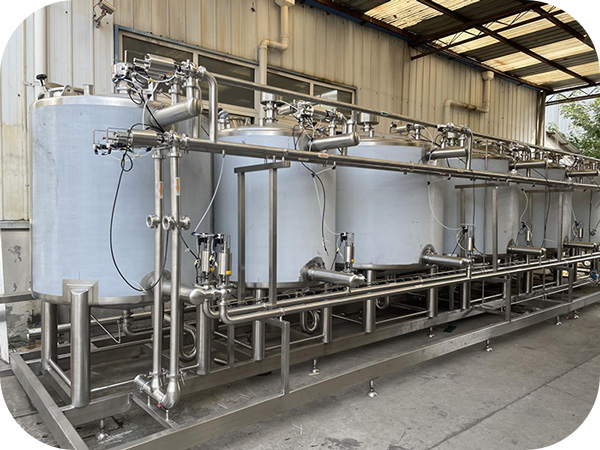
Working principle and technical characteristics
The CIP system is mainly based on the action of cyclic flushing and chemical agents, and achieves efficient and convenient cleaning processes through automated control. Its working principle can be summarized as the following steps:
1. Cleaning solution preparation:
Select the appropriate cleaning solution formula and concentration according to the cleaning needs. Common cleaning solutions include concentrated acid (such as 1% -2% nitric acid solution) and concentrated alkali (such as 1% -3% sodium hydroxide solution). Different countries have different standard requirements for this. Kunshan Wanaifu Machinery Co., Ltd. once provided a fully automatic CIP system to American customers.
2. Transport and circulation:
Use a transport pump to transport the cleaning solution to the pipelines and equipment being cleaned. The cleaning solution forms a high-speed flow inside pipelines and equipment, and through mechanical and chemical processes such as flushing, dissolution, and dispersion, removes dirt, oil stains, residues, etc. from the surface of the equipment and carries them away.
3. Concentration and temperature control:
During the cleaning process, the system monitors the changes in cleaning solution concentration and promptly replenishes it to ensure optimal cleaning effectiveness. Additionally, a heating device adjusts the temperature of the cleaning solution, typically maintaining it at no less than 60 ℃, to enhance both the cleaning speed and efficacy.
4. Waste liquid treatment:
The cleaned waste liquid is collected through a recycling system for neutralization, filtration, separation, and other treatments to remove impurities and pollutants. The treated waste liquid can be reused or safely discharged according to the actual situation.
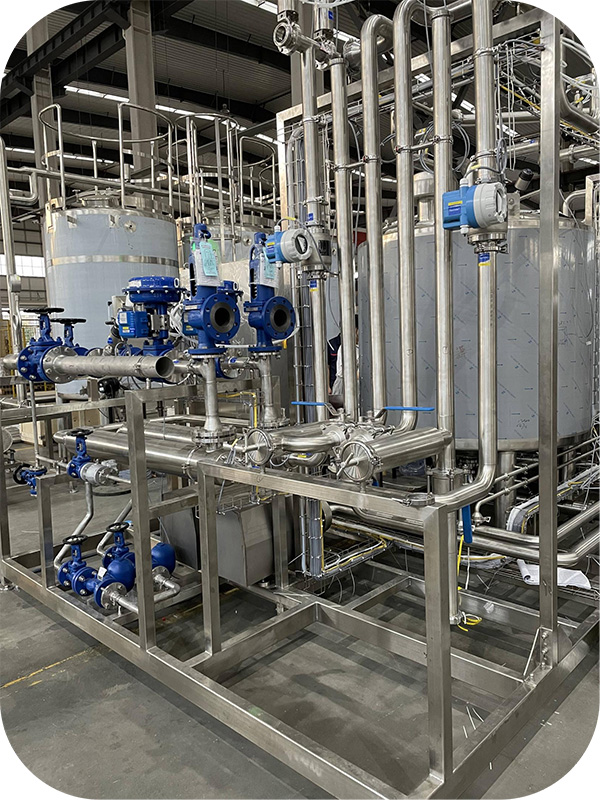
CIP system composition and classification
The CIP cleaning system mainly consists of single or multiple cleaning solution storage tanks and pipelines, distributors, booster pumps, reflux pumps, pneumatic control valve arrays, acid-base metering pumps, plate heat exchangers, temperature controllers, conductivity detectors, liquid level controllers, PLC touch screens, and control cabinets.
According to its working principle and technical characteristics, CIP cleaning systems can be divided into the following categories:
1. Single tank system:
suitable for small production lines, with low cost but limited cleaning effect.
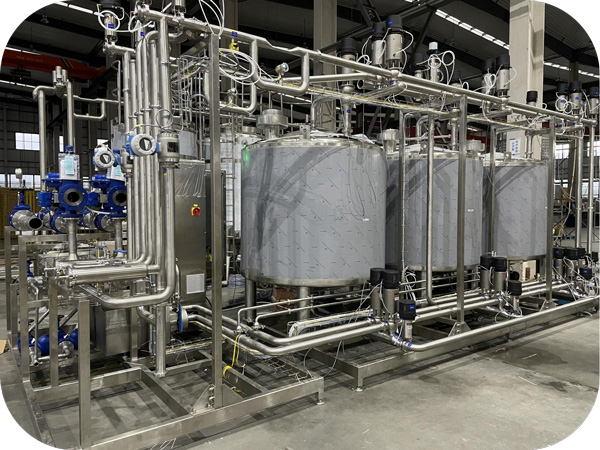
2. Multi tank system:
capable of automatic switching between different cleaning agents, suitable for large-scale production lines, with better cleaning effects.
3. Fully automatic system:
Integrated with intelligent control module, it can automatically complete cleaning tasks according to preset programs, greatly improving work efficiency.
Advantages and disadvantages of CIP system
The CIP cleaning system has many advantages:
● Efficiency: Able to complete a large amount of equipment cleaning work in a short period of time, improving production efficiency.
● High cleanliness: Through the action of cyclic flushing and chemical agents, the dirt and residue on the surface of the equipment can be thoroughly removed.
● Save manpower: achieve automated control, reduce manual operation steps, and lower labor costs.
● Protecting equipment: Avoiding damage and wear caused by equipment disassembly and assembly in traditional cleaning methods.
However, the CIP cleaning system also has some drawbacks:
● There is a special odor: the smell of cleaning solution may cause discomfort to operators.
● Requires certain storage conditions: The cleaning solution needs to be stored properly to prevent volatilization and leakage.
● The sterilization effect varies greatly with different concentrations: the concentration of cleaning solution has a significant impact on the sterilization effect and needs to be strictly controlled.
Development Trends and Prospects of CIP Systems
As mechanization and automation in food production continue to improve, CIP systems have undergone extensive research and found widespread application. The future development of CIP cleaning systems is poised to follow these trends:
● Intelligence: By integrating IoT technology and big data analysis, the intelligence level of CIP systems can be improved to achieve more accurate cleaning control and maintenance management.
● Environmental protection: One key direction for the future evolution of CIP systems is to minimize water consumption and the use of chemical cleaning agents.
● Modular design: This allows for quick adjustments to configurations based on various application scenarios, thereby reducing customization costs.
In summary, CIP cleaning systems are growing in importance in food production due to their efficiency, convenience, and intelligent features. With ongoing technological advancements and increasing market standardization, CIP cleaning systems will continue to bolster hygiene, safety, and sustainable development in the food industry.
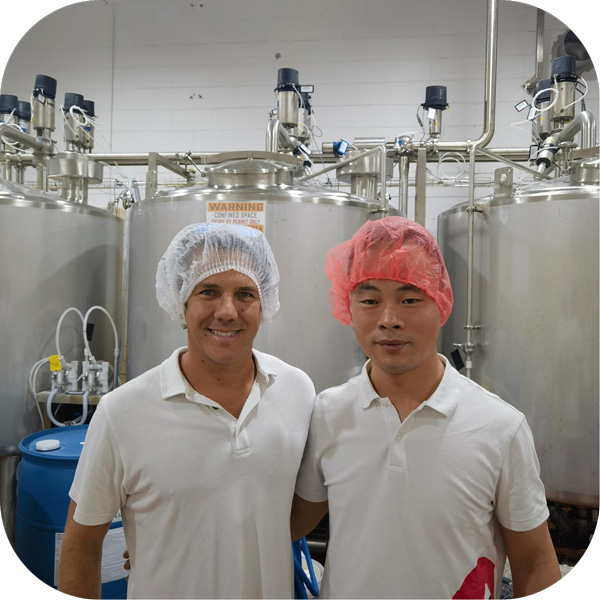
*The above pictures were taken and displayed with the customer's consent


