1. Define Your Cleaning Requirements
Cleaning requirements are the primary factor influencing CIP system selection.
Different products and processes have distinct cleaning demands, such as:
- High-fat, high-protein products (dairy)
- High-sugar, high-viscosity products (juices, sauces)
· Product type · Contamination characteristics · Cleaning frequency · Sanitation level · High-volume, frequent changeover production lines. Before selecting a CIP system, thoroughly understand: Cleaning targets (tanks, piping, heat exchangers, filling machines), Cleaning frequency, Sanitation level requirements.
2.Cost-benefit maximization
Before discussing this topic, let's understand the basic types of CIP systems:
Application Scenarios Types of CIP Systems and Applications
I. Classification by Structural
1.Whole Set CIP system Capacity: 500L–1500L Three-in-one tank design. Suitable for small-scale production lines or single-product processes. Simple structure, low investment cost.
2.Seperate Vertical systemCapacity: 1000L–unlimited (customizable) Applications: Fluid-based food products. Typically used in beverage plants, juice factories, dairy plants, etc. Centralized CIP System: One CIP station serves multiple production lines, suitable for large-scale food and beverage plants. Production lines typically exceed 10 tons per day.
3. Mobile CIP system 20L-50L Flexible design ideal for pilot lines, retrofit projects, or supplemental cleaning needs. Commonly used in small breweries and craft breweries.
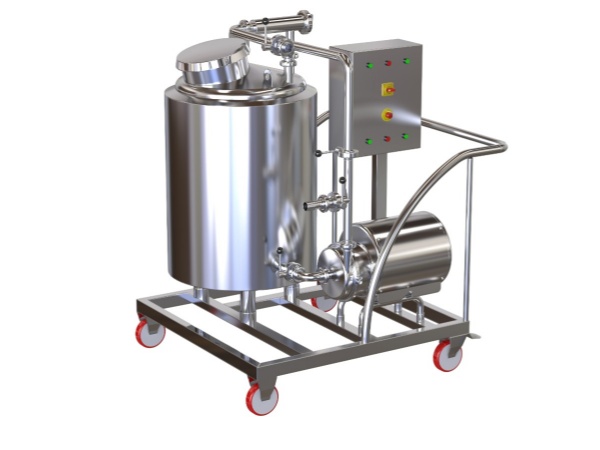 Mobile CIP system
II. By Control Type
Fully Automatic: PLC fully controls the entire CIP process. Operators only need to select the formula and click start for the CIP operation.
Semi-Automatic: Valves require manual control, while temperature is automatically controlled by PLC. The key difference lies in PLC control of the entire process versus manual valve operation.
When evaluating CIP system ROI, comprehensively consider the following factors:
a. Customer requirements and cleaning standards
- Production capacity: Different capacities require different CIP types. Generally, CIP systems for large-scale production incur higher costs.
- Customer requirements: Whether semi-automatic or fully automatic is needed, and the customer's budget is also crucial.
- Cleaning requirements refer to hygiene standards. Typically, pharmaceuticals demand the highest hygiene standards, followed by the food industry, with dairy products having the strictest requirements.
b. Automation Level and Maintenance
Costs Fully automated CIP systems offer higher production efficiency, lower labor costs, reduced error rates, and greater profitability. However, they require a higher initial investment and incur high costs for replacing parts due to normal wear and tear. Semi-automated CIP systems rely more heavily on manual labor, entail lower upfront costs, and have relatively lower maintenance expenses. Yet, they carry the risk of human error, which may lead to production losses. Overall, maintenance costs for fully automated CIP systems are substantially higher than those for semi-automated systems.
c. Energy Consumption and Resource Efficiency
Water consumption and cleaning solution recovery capacity
Heating methods and energy utilization efficiency
Water-saving and energy-efficient designs can significantly reduce operating costs
Durability and Stability of CIP Systems
Durability determines the true cost of ownership for a CIP system over 5–10 years. Key considerations:
Material (food-grade stainless steel SUS304/316L). Generally, 316L offers superior corrosion resistance, though material thickness also matters. For small-scale CIP systems, SUS304 may be used to reduce costs.
Acid/alkali concentration: Varies by product. Typically, acid concentration ranges from 1–1.5, while alkali concentration ranges from 2–2.5.
Critical Component Configuration: Includes valves, piping, seals, etc.
Actual Operational Cases and Stability
Selecting the Right Partner and Engineering Support
Compared to suppliers offering only equipment, partners capable of providing comprehensive CIP process solutions are preferable.
Quality suppliers typically possess:
- Extensive industry success cases
- Customized CIP process design capabilities
- Comprehensive commissioning and after-sales service
Selecting the right CIP process is essential for achieving long-term stable production
Choosing an appropriate CIP system is not merely equipment procurement but a systemic decision impacting food safety, production efficiency, and long-term operational costs.


